Castle Game Engine brings the power of open-source game creation to developers across platforms with a flexible editor, a Pascal-based programming core, and an active community eager to build immersive games. In this blog post, we’ll unpack how this engine stands out in the modern game development landscape, explore its strengths, and walk through practical ways developers — from hobbyists to professionals — can leverage it for their next project.
What Is Castle Game Engine?
Castle Game Engine is a free, open-source platform for creating interactive 3D and 2D games and applications. It’s designed to be cross-platform — meaning you can build a project once and deploy it across desktop, mobile, web, and even gaming consoles.
At its core, Castle Game Engine provides:
A visual editor for constructing worlds, scenes, interfaces, and behaviors.
A powerful set of components for rendering graphics, managing scenes, handling user input, and more.
Support for standard asset formats like glTF and X3D, making it easy to work with tools like Blender or Maya.
And because the engine is completely open-source, both commercial and non-commercial developers are free to use, modify, and extend it as needed — a true boon for creative communities worldwide.
A Deep Dive Into Castle Game Engine Features
1. Cross-Platform Support — Build Anywhere, Run Everywhere
This truly “write once, deploy everywhere” paradigm opens doors for indie developers who might be limited by resources or time but still want their creations on as many platforms as possible.
Developer Advantage
Save time with unified asset pipelines.
Reach wider audiences without rewriting your game.
Simplify updates and fixes across platforms.
2. Visual Editor — Build Worlds With Real Tools
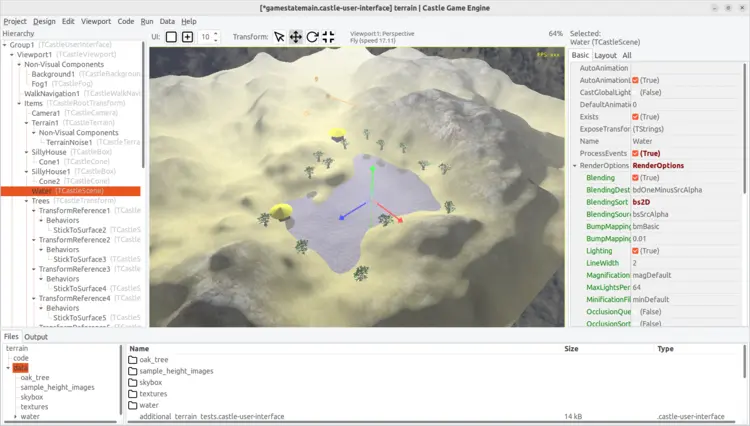
Game engines often offer visual editors, but Castle Game Engine’s approach blends simplicity with capability. Its editor lets creators visually design game scenes, user interfaces, and environments without diving straight into code.
With anchor-based UI design and automatic scaling, you can build interfaces that look good on any screen size. Scene hierarchy, previews, and drag-and-drop asset imports speed up prototyping and iteration.
This editor is helpful not only for artists and designers but also for programmers who want to see changes in real time and refine gameplay mechanics efficiently.
3. Powerful Graphics and Rendering
Whether you’re developing a stylized 2D platformer or a full 3D adventure, Castle Game Engine equips you with robust graphics capabilities. Key features include:
Physically Based Rendering for realistic lighting and materials.
Shader support and post-processing effects.
Shadow mapping and mirrored reflections.
Support for multiple formats like glTF and X3D.
Thanks to support for modern OpenGL and WebGL, developers can create visually rich environments while still maintaining performance.
4. Integrated Asset Format Support
Asset workflows matter — especially when dealing with models, animations, and multimedia. Castle Game Engine supports key industry formats out-of-the-box:
glTF — efficient and modern format for 3D assets.
X3D — versatile scene graph format.
IFC and more, which enhance compatibility with architecture and CAD tools.
This interoperability means you can build assets in tools like Blender, export them to compatible formats, and integrate them seamlessly into your game or visualization.
Why Choose Castle Game Engine for Your Next Project?
Flexibility Through Pascal
Many engines use scripting languages or proprietary languages, but Castle Game Engine takes a different path: it is powered by modern Object Pascal.
Pascal is known for its clarity and performance, offering strong type safety and readable syntax — especially appealing to developers drawn to structured, high-productivity languages.
This choice allows:
Fast execution and compilation.
Clear code structure for large projects.
Compatibility with Free Pascal Compiler (FPC) and Delphi tools.
Whether you are a beginner exploring programming or a seasoned developer building complex systems, Object Pascal provides a balanced blend of speed and expressiveness.
Open-Source Community and Continuous Integration
Because it’s open-source, Castle Game Engine thrives on community support. Developers can:
Dive into the GitHub repository to explore source code, examples, and tools.
Join forums, Discord channels, and community discussions to troubleshoot issues and collaborate.
Use established CI/CD tools like GitHub Actions or GitLab CI to automate builds, tests, and deployments.
This community focus creates a feedback loop: as more developers contribute, the engine becomes more capable and better documented.
How Castle Game Engine Empowers Modern Game Development
1. Prototyping Made Easy
From the moment you launch the editor, the workflow encourages rapid experimentation:
Import assets quickly.
Build scenes visually.
Preview gameplay in real time.
This iterative design cycle lets creators validate ideas early, catch design flaws, and polish experiences faster.
2. All-In One Toolkit
Traditional game development might require:
Separate graphics tools.
Physics engines.
UI frameworks.
Deployment pipelines.
Castle Game Engine combines these into one coherent environment — reducing toolchain complexity and improving productivity.
3. Education and Learning
Because it’s open-source and approachable, many educators use Castle Game Engine for teaching game development. It’s useful in academic settings where students explore graphics programming, scene design, and cross-platform issues without expensive licensing fees.
Tips for New Developers Getting Started
Ready to dive in? Here are some pointers:
Start with the Visual Editor — get comfortable before adding code.
Use Sample Projects — many open-source examples exist that illustrate common patterns.
Join the Community — ask questions, explore shared scripts, and learn best practices.
Leverage Your IDE — tools like VS Code, Lazarus, or Delphi enhance your workflow greatly.
Conclusion — Why Castle Game Engine Matters
In a world dominated by commercial and closed-source tools, Castle Game Engine stands out as a versatile, open, and powerful choice for indie developers, educators, and hobbyists alike.
From its broad platform reach to its feature-rich editor and graphics capabilities, it proves that open-source game development can be both accessible and capable. Whether you’re building your first 2D platformer or an ambitious 3D simulation, this engine offers the tools you need — backed by a community that continues to grow.